The quick timer game with mates is the fastest format to launch when the night starts dragging: zero gear, rules explained in 20 seconds, and everyone's in. But between the ascending stopwatch (measuring who does it fastest) and the countdown timer (you've got X seconds to answer before the beep), the two mechanics don't create the same vibe. One's pure competition, the other's collective pressure. In this article, we break down both formats, tell you which fits your crew, and give you concrete examples to launch tonight.
- Ascending stopwatch vs countdown timer: what's the real difference?
- The game in stopwatch mode: measuring and breaking records
- The game in countdown mode: the beep that puts pressure on
- Quick recap table: stopwatch or timer depending on your night
- 3 quick timer games to launch with zero prep
- The mistakes that kill the vibe of a quick timer game
- Want more quick timer games? The app's already got you covered
- FAQ – Quick timer games with friends
Ascending stopwatch vs countdown timer: what's the real difference? ⏱️
Before you pick your format, you need to understand what actually sets them apart. On the surface, both involve time. But the logic behind them is completely opposite — and that changes everything about your night's vibe.
The ascending stopwatch: starting from zero
With an ascending stopwatch, the counter starts at 0:00 and you measure the time elapsed. The goal? Finish as fast as possible. It's the logic of sports competition: who racks up the most answers in record time, who completes the challenge in fewer seconds. The stopwatch stops when the task is done. Result: you compare scores, run it again to beat the record, and it creates a momentum of pushing yourself.
- The player controls their own pace — they can speed up or slow down
- Tension builds gradually as time ticks by
- Perfect for individual challenges or teams going head-to-head
- The score (the time) is objective and undisputable — or nearly
The countdown timer: the beep that's coming
The countdown timer is the opposite: you set a limit (5 seconds, 30 seconds, 1 minute) and the counter goes down to zero. When it beeps, you're done — whether you've answered or not. It's the logic of collective pressure: everyone watches the timer, everyone feels the stress, and the final beep always triggers a reaction (laughter, screams, forfeits). It's less competitive but more immersive for the whole group.
- Maximum pressure in the final seconds — countdown effect guaranteed
- The whole group feels the tension at the same time, even the spectators
- Perfect for quick-answer games, hot-potato challenges or themed rounds
- The format is more inclusive: even the non-competitive types have fun
In a nutshell: two philosophies
The ascending stopwatch says "prove you're the fastest". The countdown timer says "answer before it beeps or you're out". One creates heroes, the other creates willing victims. Both are excellent — but not in the same situations.
The game in stopwatch mode: measuring and breaking records 🏁
The ascending stopwatch format is the playground for perfectionists and competitors. You start the stopwatch, do your thing, stop it. Simple. Brutal. Effective. Here's everything you need to know to master it.
The principle in detail
A player (or team) gets a challenge or task to complete. The stopwatch starts on the signal. As soon as the task is done, the stopwatch stops. The time is recorded. The next player tries to do better. At the end of the round, the fastest wins — or the slowest takes a forfeit, depending on your rules.
Examples of ascending stopwatch games you can play IRL
- The express list: Name 10 countries, 10 car brands, 10 names starting with a given letter — as fast as possible. You measure the time, you beat the group record.
- The mime challenge: Get your team to guess a word through mime. The stopwatch stops when the word is guessed. The fastest team wins the round.
- The table round: Each player says a word in a category (fruits, capitals, films...) without repeating. You measure how long the group lasts before someone gets stuck.
- The physical challenge: Do 10 push-ups, juggle 3 objects, stack bottle caps — fastest wins. Perfect for waking up a dragging night.
- The word chain: Each player chains a word that starts with the last letter of the previous word. You measure how long the chain lasts without a pause longer than 3 seconds.
Which groups is this made for?
The ascending stopwatch shines with groups that know each other well and like to wind each other up. It's the ideal format for nights where the energy's already there and everyone wants to compete. On the other hand, with people who don't know each other well or a shy group, it can quickly make people uncomfortable — the pressure to "perform" in front of everyone can shut people down.
- Close mates: perfect
- Mid or late night (when the vibe is hot): perfect
- Groups of 3 to 8 players: ideal
- Icebreaker with strangers: avoid it, go for the countdown timer instead
The game in countdown mode: the beep that puts pressure on ⏰
The countdown timer is the favourite mechanic for nights where everyone needs to be in on it — even the non-competitive types. The countdown pressure is universal: nobody escapes it, everyone laughs (or stresses) together.
The principle in detail
You set a duration before the round starts: 5 seconds for a quick answer, 30 seconds for a challenge, 1 minute for a more complex task. The timer is launched, visible to all. The player must complete their mission before the beep. If they fail, they take a forfeit (or lose a point). The magic of the countdown is that the final seconds always create a moment of collective madness — everyone counts down out loud, nobody can help it.
The durations and what they create
- 5 seconds: Instinctive answer, zero thinking time. Perfect for light trivia questions or word associations. Stress is maxed out, answers are often hilarious.
- 15-30 seconds: The sweet spot. Short enough to create pressure, long enough for the player to have a real chance. Ideal for mime challenges, riddles or themed rounds.
- 1 minute: "Hot potato" format or physical challenge. The player has time to sweat — and so does the group. Perfect for creative challenges or impressions.
Examples of countdown timer games you can play IRL
- Hot potato: An object gets passed hand to hand. Whoever's holding it when the timer beeps takes a forfeit. Simple, universal, effective.
- 5 seconds to answer: "Name 3 countries starting with A." Timer at 5 seconds. If you freeze, you lose. The classic format that never gets old.
- Express mime: 30 seconds to get your team to guess a word. If the word isn't guessed by the beep, the other team scores a point.
- Cascade categories: Each player has 5 seconds to name something in a category. Whoever repeats or freezes is out. Keep going until one person's left.
- Impression challenge: 30 seconds to do an impression of a celebrity, animal or character. The group votes for the best one before the next beep.
Which groups is this made for?
The countdown timer is the most inclusive format there is. It works with every group, every energy level, and especially at the start of the night to break the ice. The pressure is shared — even spectators stress — which creates instant bonding.
- Mixed groups (people who don't know each other or barely do): perfect
- Start of night for icebreaker: perfect
- Groups of 4 to 12 players: ideal
- Family nights or mixed-profile groups: excellent choice
"There were 8 of us, barely knew each other. I launched a 5-second timer on film themes — in 10 minutes, everyone was shouting answers at the same time. That awkward silence at the start of the night? You won't hear about it again."
Quick recap table: stopwatch or timer depending on your night 📊
No time to read the whole article before launching the game? Fair. Here's the table that gives you the answer in 10 seconds flat.
| Criteria | Ascending stopwatch ⏱️ | Countdown timer ⏰ |
|---|---|---|
| Principle | You measure elapsed time — whoever finishes fastest wins | You set a limit — answer before the beep or you lose |
| Pressure felt | Progressive, individual — you're competing against yourself | Collective and sudden — the whole group stresses together |
| Ideal for (number of players) | 3 to 8 players — works well in one-on-one too | 4 to 12 players — more fun with more people |
| Recommended time of night | Mid or late night — when the vibe is already hot | Start of night — excellent icebreaker |
| Energy level required | High — players need to want to compete | Moderate — even the quietest types get into it |
| Risk of failure | Can make non-competitive types uncomfortable | Can create disputes over answer validity |
| Equipment needed | A stopwatch (phone or app) + a referee | A visible timer (app recommended) |
| Duration of a round | Variable depending on challenge — often 30 sec to 2 min per player | Fixed and predictable — 5 to 60 seconds per turn |
| Icebreaker? | Not ideal with strangers | Excellent — shared pressure creates connection |
| Replayability | High — you always want to beat your record | High — you always want revenge on the forfeit |
3 quick timer games to launch with zero prep 🎯
No cards, no board, no prep. These three games launch in under 30 seconds with just a phone (or even without). We've put the rules in 3 lines max — because if you need a manual, you've already lost.
Game 1 — "The Express List" (ascending stopwatch mode)
- A player picks a category: European countries, car brands, names starting with M, films with a robot…
- The stopwatch starts. The player names as many items as possible without repeating. The stopwatch stops when they freeze or say "stop".
- The score = number of items named ÷ time elapsed. The next player tries to do better. Whoever has the best ratio wins the round.
Variation: set a target number (name 10 items) and measure who gets there fastest. Simpler, more direct.
Game 2 — "5 Seconds Flat" (countdown timer mode)
- A player asks a question like "Name 3 [category]" — sea animals, capitals, action film actors, etc.
- The timer launches at 5 seconds. The target player must name 3 valid items before the beep.
- If they succeed, they ask the next question to someone else. If they fail, they take a forfeit (or lose a point). The game continues until a player reaches 3 forfeits.
Pro tip: the funniest categories are the ones where everyone thinks the answer's easy… until the timer starts ticking.
Game 3 — "The Human Bomb" (hybrid stopwatch + timer)
- A timer is set between 1 and 3 minutes (secret duration if possible). Any object (bottle, cushion, phone) acts as the "bomb".
- Players pass the object around, each answering a question posed by the previous player (any category). As soon as you answer, you pass the bomb.
- Whoever's holding the bomb when the timer beeps takes a forfeit. Tension builds because nobody knows when it'll go off.
Stopwatch variation: instead of a secret timer, the stopwatch is visible — but the rule is to pass the bomb as fast as possible. Whoever holds it longest in total (cumulative stopwatch time) loses.
The Human Bomb is the format that turns any cushion into an object of collective terror. When the timer beeps, the group's reaction is worth launching the game for alone.
The mistakes that kill the vibe of a quick timer game 💀
A badly run quick timer game is worse than no game at all. Ever been in that moment where a dispute over "you went over time" kills the whole night's energy? Here's how to avoid it.
Mistake 1: The timer's too long
Setting a timer for 5 minutes on a simple question kills the suspense before it starts. The golden rule: shorter is funnier. For quick answers, stick to 5-30 seconds. For physical or creative challenges, 1 minute max. Beyond that, spectators check out and the active player feels judged.
Mistake 2: Fuzzy rules on what counts as "valid"
"Does Monaco count as a country?" "I said the word before the beep but you didn't hear it." These disputes happen every time if the rules aren't clear before you launch. The fix: 30 seconds of clear rules before the first round, and a designated referee whose decision is final — no appeals, no debate.
Mistake 3: One player manages the timer on their phone
Classic nightmare: the player managing the stopwatch is also playing, or they're distracted by a notification. Result: the timer starts late, stops too early, or nobody really knows how much time passed. The fix: a timer visible to everyone (phone screen facing the group) or a dedicated app that displays the countdown big.
Mistake 4: Forfeits that are too heavy or humiliating
Forfeits are there to spice things up, not to put someone in an uncomfortable spot. A well-balanced forfeit (do an impression of someone in the group, sing a song lyric, do 10 squats) creates laughs. A humiliating forfeit creates discomfort and people who "don't want to play anymore". Keep it light, especially early in the night.
Mistake 5: Not switching up the formats
Doing 10 rounds of 5-second countdown timers in a row is exhausting. Even the best format gets old if you don't vary it. Switch between ascending stopwatch and countdown timer, mix up the themes, change the rules between rounds. A quick timer game should stay a fun 5-10 minute break, not a marathon session.
Rule number 1 of quick timer games: if you spend more time explaining the rules than playing, the rules are too complicated. Simplify, launch, adjust as you go.
Want more quick timer games? The app's already got you covered 📱
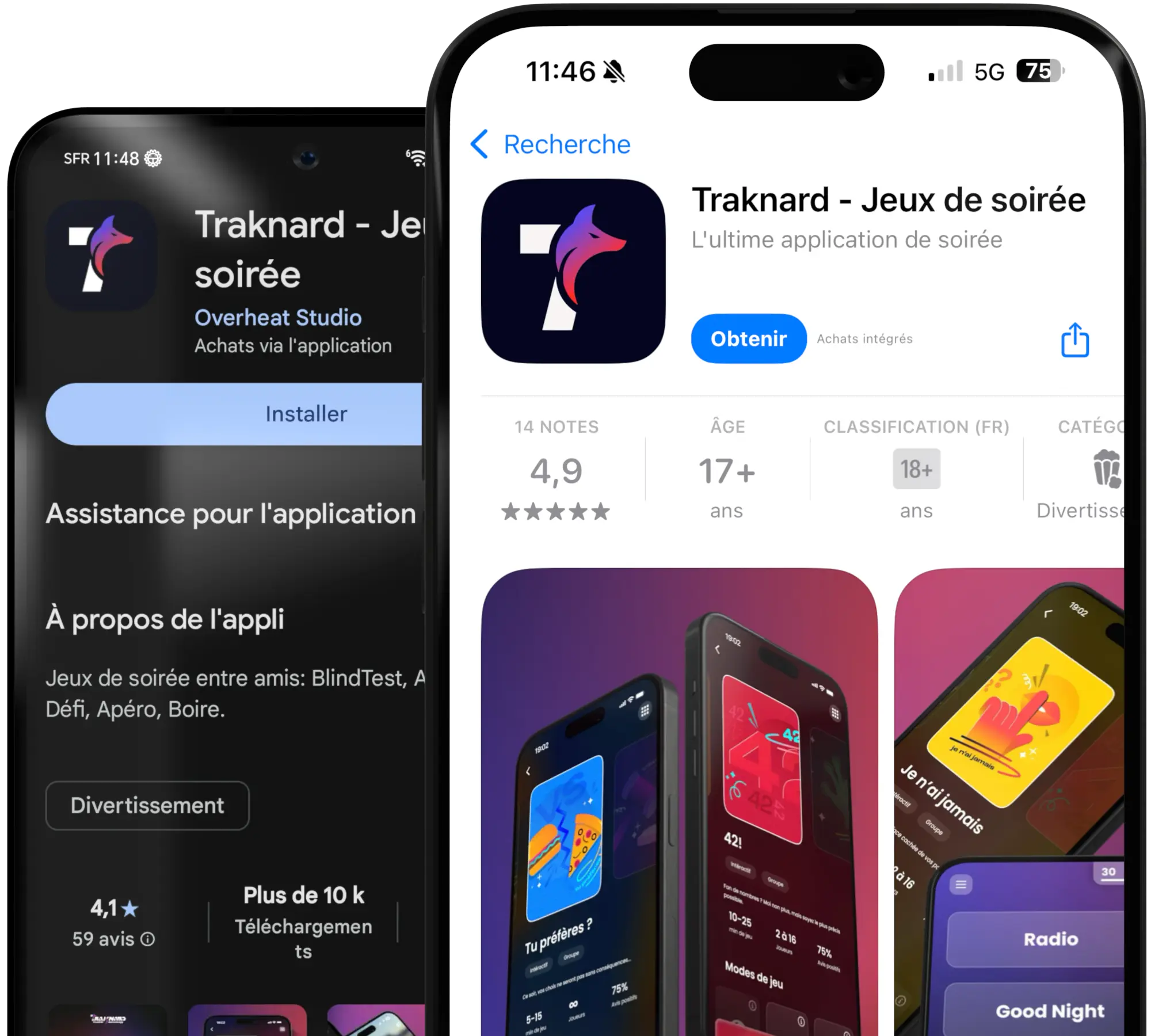
Managing the timer on your phone while playing is a guaranteed nightmare. Who hits "start"? Who validates the time? What if a notification pops up at the wrong moment? That's exactly why Traknard has a dedicated Interactions section for IRL party games with built-in timer.
In Traknard Interactions, you'll find The Stopwatch and The Timer straight in the app — no juggling between your phone's clock and the game. The timer is visible to everyone, the stopwatch is neutral and undisputable. No more disputes over "you went over time". And as a bonus, you can chain it with other interactions like Caps, Poker Face or Staring Contest without having to look up the rules.
If you want to take the night even further, Traknard Games are there to take over: Truth or Dare for confessions that hit hard, The Tribunal to judge the group's worst moments, or Would You Rather for impossible dilemmas that reveal everything about everyone. And if you want to test your music knowledge, the built-in Blind Test is perfect for ending the night on a high.
For moments when you just want to let chance decide, Traknard Arcades (Coin Flip, Roulette, Selector) do the job in two taps.
All in one app, no ads, no forced sign-up. Pull out your phone, launch it, and the night's back on.
In summary 🎯
To choose between stopwatch and timer:
→ Ascending stopwatch if your group is competitive and the vibe's already hot. Countdown timer if you want to break the ice or include everyone.
For groups that don't know each other well:
→ Start with the countdown timer on light themes — the shared pressure creates connection without putting anyone in the spotlight.
To avoid disputes:
→ Designate a referee before you launch, set the rules in 30 seconds, and use an app with a visible timer for everyone rather than your phone's native stopwatch.
For a night that lasts:
→ Switch between formats (stopwatch + timer), vary the themes, and keep rounds short (5-10 minutes max). A quick timer game is a break, not a marathon.
To play with zero prep:
→ The Express List (stopwatch), 5 Seconds Flat (timer) and The Human Bomb (hybrid) launch in 20 seconds with zero gear. And if you want everything in one tap, Traknard's already built it in.
FAQ – Quick timer games with friends ❓
What's a quick timer game with friends?
Answer: A quick timer game with friends is a fast-paced game format with zero equipment where time is the central mechanic that creates tension and fun. Either you measure who completes a task fastest (ascending stopwatch), or you set a time limit before which they need to answer (countdown timer). In both cases, a 20-second rule explanation is enough to launch — and that's exactly what makes it the perfect format to revive a dragging night.
What's the minimum number of players for a quick timer game?
Answer: Most formats work from 3 players on, and some work from 2 in direct one-on-one mode (ascending stopwatch on a physical challenge or a list). The countdown timer is really more fun from 4-5 players on: the collective pressure is stronger, the group's reactions are funnier, and the hot potato has more hands to pass through. Beyond 10-12 players, think about creating teams so everyone stays active.
What's the ideal duration for a quick timer game at a party?
Answer: The most effective formats last 5-30 seconds per turn — short enough to maintain tension, long enough for the player to have a real shot. A complete round (everyone plays once) usually takes 5-10 minutes. That's the perfect length for a fun break without disrupting the night's flow. If a round goes over 15 minutes, it usually means turns are too long or the rules are too complicated.
Can you play a quick timer game without a smartphone?
Answer: Absolutely. You can count out loud together ("3, 2, 1, beep!"), clap at regular intervals, or use an hourglass if you've got one lying around. It works, but it usually creates disputes about time accuracy. A dedicated app like Traknard avoids these arguments by displaying a visible, neutral timer for the whole group — and that's often the difference between a smooth night and a dispute that kills the vibe.
Which quick timer game should you pick to break the ice with people you don't know well?
Answer: In that case, definitely go for the countdown timer on light, universal themes: names, countries, colours, animals, famous films. The "5 Seconds Flat" format is perfect — everyone knows the rules in 10 seconds, nobody gets put on the spot in an awkward way, and the shared pressure naturally creates connection. Avoid competitive ascending stopwatch as an icebreaker: the pressure to "perform" in front of strangers can shut shy people down.
How do you avoid disputes over the timer during a quick timer game?
Answer: Two simple rules. First, designate a neutral referee before you launch — someone not playing that round whose decision is final, no appeals. Second, use an app with a visible timer for everyone rather than your phone's native stopwatch: when everyone sees the same countdown, there's no more "you didn't go over time" possible. Clarifying what counts as a valid answer before the first round eliminates 90% of disputes.
Can a quick timer game be played without alcohol?
Answer: Absolutely, and it's actually recommended for mixed groups. The timer mechanic works perfectly with any drink — juice, soda, sparkling water, mocktail. Forfeits can be completely alcohol-free: do an impression, sing a chorus, do squats, tell an embarrassing story. The fun comes from time ticking and collective pressure, not what's in the glasses. Traknard is for 18+, consume responsibly.
Which quick timer games work just as well outdoors (patio, camping)?
Answer: Equipment-free formats adapt anywhere: spoken themes (The Express List, 5 Seconds Flat), light physical challenges (10 squats in under 20 seconds, juggling an object), or The Human Bomb with any object at hand. Outdoors, physical challenges are even more fun — you've got space. On the other hand, games needing a table, cards or a screen readable in bright sunlight are trickier. An app with a big visible timer is still useful even on a patio.
The real question isn't "stopwatch or timer?". It's "what are you waiting for to launch the game?" 🔥