
For an integration party that actually breaks the ice, you need games that get people talking — not games that scare off the shy ones. Whether it's for a weekend getaway, a student union event or your first week on campus, we've picked 10 tried-and-tested games to help everyone get to know each other without awkwardness, without complicated equipment and without anyone hiding in a corner scrolling their phone. Some take 5 minutes, others can run all night — pick what suits the vibe.
- Why the right game changes everything at an integration event
- Quick icebreaker games (5-10 min) to kick off the night
- Team games to build cohesion
- App-based games to keep things going without prep
- Drinking games (and their alcohol-free alternatives)
- 3 tips to run an integration party that slaps
- Quick guide: which game for which moment?
- FAQ
Why the right game changes everything at an integration event 🎯
An integration party without activities? That's 30 strangers staring at their shoes, scrolling Instagram waiting for someone to take the lead. Spoiler: without a game, nobody takes the lead. The right game creates a natural reason to talk — you don't have to "introduce yourself", you just play and conversation flows naturally.
Icebreaker games are the #1 tool for building group cohesion fast because they level the playing field: whether you're the most outgoing or the shyest person in the group, the rules are the same for everyone. In 10 minutes of the right game, people who've never met can already be laughing together — that's the magic.
What makes a good integration game
- Inclusive: everyone can play, regardless of how socially comfortable they are or how much they drink.
- No heavy equipment: no board games, no cards to print, no projector to hunt down at 11pm.
- Scales with group size: works just as well with 8 people as with 40 — because integration groups are rarely stable.
- Short or flexible: you can wrap up when the vibe is right, or keep going if the group's into it.
- No humiliation: a good integration game puts people at ease, it doesn't make them uncomfortable. That's the line.
Quick icebreaker games (5-10 min) to kick off the night ⚡
The first 30 minutes of an integration party are the trickiest. People arrive in small groups, stick with who they already know, and nobody really dares to approach strangers. These 4 games are designed exactly for that moment: quick, no equipment, and brutally effective at forcing those first interactions.
1. Two Truths, One Lie
- Rules: each player says 3 statements about themselves (2 true, 1 false). Everyone votes to find the lie.
- Why it works: it gets people to open up a bit, creates surprises ("wait, you actually rock climbed in Peru?!") and sparks natural conversations after each round.
- Pro tip: encourage unusual anecdotes — obvious lies aren't as fun.
2. Human Bingo
- Rules: each player gets a grid with squares like "failed an exam", "speaks a foreign language", "only child", etc. You find a different person in the group for each square and write their name. First to complete a line shouts "Bingo!"
- Why it works: it literally forces everyone to talk to strangers. Impossible to stay in your corner.
- Pro tip: if you don't want to print, replace the grid with a list of questions to ask out loud in a circle.
3. Name-Adjective
- Rules: each player introduces themselves with their name + an adjective starting with the same letter that describes them ("I'm Leo, I'm Lively"). The next player repeats all previous names-adjectives before adding their own.
- Why it works: it's both a memory game and an introduction game. People remember names way faster, and the adjectives chosen usually get big laughs.
- Pro tip: keep it to 15-20 people max so it stays manageable.
4. Quick-Fire Questions in a Circle
- Rules: a host asks quick questions in turn (or everyone asks their neighbour). Questions are light: "beach or mountains?", "early bird or night owl?", "favourite film?". No wrong answers, no dares.
- Why it works: super simple, zero pressure, and you find common ground with strangers in minutes.
- Pro tip: to spice it up, use more creative questions like "if you were a cartoon character, who'd you be?"
Team games to build cohesion 🤝
Once the ice is broken, the next step is creating real group dynamics. Team games are perfect for that — as long as you mix up the teams from the start so nobody stays with their school mates. That's when real bonds form.
5. Blind Test
- Rules: a host plays song clips (5-10 seconds), teams write their guesses on paper or in an app. Possible themes: 2000s hits, film soundtracks, TV theme songs, video game music...
- Why it works: blind tests create a fun competitive vibe, bring out shared cultural references and spark passionate debates ("no way, that's definitely Rihanna, I swear!").
- Pro tip: on Traknard, the Blind Test mode is built right into the app — zero prep, hundreds of tracks available, automatic scoring. Perfect for student unions who want to run things without 3 hours of setup.
6. General Knowledge / Campus Quiz
- Rules: team questions on various topics. For integration, mix general knowledge with campus-specific questions ("how many lecture halls in building A?", "what's the director's name?") so everyone learns useful info while having fun.
- Why it works: builds team chemistry and helps newcomers get familiar with their new environment.
- Pro tip: alternate easy and trick questions so everyone gets to shine at some point.
7. Mini-Olympics
- Rules: a series of physical and mental challenges in teams — paper toss into a bin, build the tallest cup tower, mime films in 30 seconds, etc. Each challenge earns points, highest-scoring team wins.
- Why it works: mini-olympics create incredible collective energy. People cheer each other on, laugh at their failures and leave with shared memories.
- Pro tip: mix physical, creative and knowledge-based challenges so everyone can excel at something.
8. Truth or Dare in Teams
- Rules: the classic revisited in teams — one team asks a member of the other team "Truth or Dare?". Questions and dares are calibrated to help people get to know each other, not to humiliate.
- Why it works: Truth or Dare on Traknard offers hundreds of questions and dares sorted by intensity — you pick the "gentle" mode for integration and turn up the heat if the group wants it. Perfect for keeping the vibe under control.
- Pro tip: always start with light questions and let the group decide if they want to escalate.
App-based games to keep things going without prep 📱
Let's be real: when you're organising an integration party for the student union, you've already handled logistics, drinks, the venue and the 15 group chats going sideways. You don't want to spend 3 hours prepping quiz sheets. That's where party apps come in.
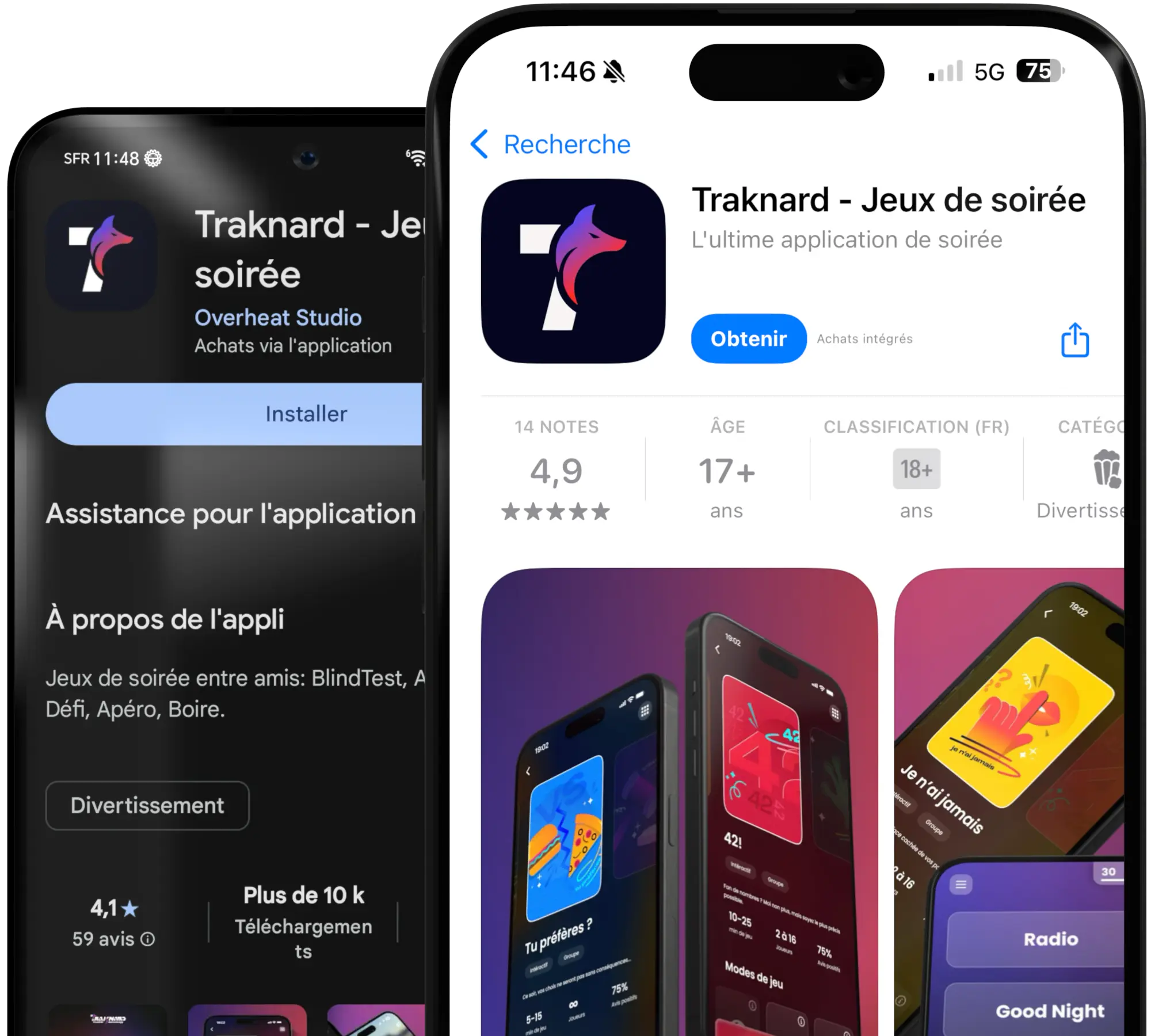
Traknard is designed exactly for this: an app that comes out of your pocket when things go quiet at 10pm and nobody knows what to do next. A few features that are particularly useful for integration:
- Games: complete games like Never Have I Ever, Would You Rather, 42! or The Tribunal — party classics with hundreds of ready-to-go questions, zero prep needed.
- Interactions: modes like Caps, Killer Eyes or Police! to animate group moments with simple, dynamic rules.
- Cards: digital card games like The Pyramid, The Bus or The Dealer — perfect for smaller groups wanting something structured.
The integration advantage? You can adjust the intensity based on the group's vibe. Gentle mode for the early hours, then gradually turn it up if everyone's keen. Zero prep, zero equipment, and the party never dies.
Drinking games (and their alcohol-free alternatives) 🥤
Let's be straight up: drinking games are part of student culture, and it'd be hypocritical to pretend they don't exist. But the good news is they work just as well with soft drinks, juice or mocktails — and often better, because everyone can play all night without things getting messy.
9. Beer Pong (soft drink version available)
- Rules: two teams compete by tossing ping-pong balls into opponent cups. When a cup gets hit, the other team drinks it (or eats a sweet, or does a dare).
- Why it works: it's a classic for a reason — creates fun competition, moments of tension and collective celebrations. The Beer Pong mode on Traknard (Interactions section) adds special rules to spice things up.
- Alcohol-free version: fill cups with soda, juice or water — the game's exactly the same. Or swap the drink for a dare: whoever misses does a challenge.
10. Never Have I Ever
- Rules: players take turns saying "Never have I ever..." followed by an action. Everyone who's done it drinks (or eats a sweet, or does a dare).
- Why it works: it's an incredible reveal — in 20 minutes you learn more about people than in 2 hours of normal chat. Unexpected revelations create instant bonds.
- Alcohol-free version: swap the drink for a points system or dares. The Never Have I Ever game on Traknard offers questions sorted by intensity so you stay in control.
Organising tip: for integration, always start with light questions in "Never Have I Ever" — "Never have I ever missed my alarm for an exam", "Never have I ever eaten a whole pizza alone". More personal questions come naturally when the group's comfortable. Nobody should feel forced to answer anything.
Traknard is for 18+. If you're playing with alcohol, drink responsibly — and remember that a taxi/Uber/designated driver is always the best way home.
3 tips to run an integration party that slaps 🔑
Beyond choosing the right games, organisation makes the difference between a party people remember and one they forget by next morning. Here's what we've learned from integration parties that actually work.
-
Mix up the teams from the start — and enforce it.
This is the most important and most ignored tip. If you let people choose their teams, they'll stick with who they already know. Result: cliques form on day one and it's really hard to break them later. Force the mix from game one — random draw, by sweet colour, by birth month — whatever, the point is nobody chooses. People complain for 30 seconds and thank you at the end of the night.
-
Alternate calm and high-energy games.
An integration party is a marathon, not a sprint. If you chain 3 hours of high-energy games, people burn out and the vibe crashes hard. The right rhythm: a calm game (verbal icebreaker), then a high-energy game (mini-olympics, blind test), then free time, then a calm game (Never Have I Ever), etc. This rhythm keeps energy up and gives shy people breathing room.
-
Always have a backup game ready.
Even the best party has quiet moments — when a game ends and nobody knows what's next. Keep 2-3 backup games in your pocket (or on Traknard) to restart the vibe instantly. A 30-second silence can kill a party; having a game ready to launch in 10 seconds changes everything. Would You Rather or 42! on Traknard are perfect for this — one question and everyone's back in it.
Quick guide: which game for which moment? 📊
To help you pick the right game for the situation, here's a quick reference table of all the games in this article. Print it, screenshot it, or keep it in mind — and remember Traknard covers several of these games directly in digital form, zero prep.
| Game | Number of players | Duration | Equipment | Energy level | Best for |
|---|---|---|---|---|---|
| Two Truths, One Lie | 4 – 30 | 10-15 min | None | 🟢 Calm | Start of night, first contacts |
| Human Bingo | 10 – 40 | 15-20 min | Printed grids (or spoken list) | 🟡 Moderate | Large group, force interactions |
| Name-Adjective | 6 – 20 | 5-10 min | None | 🟢 Calm | Remember names, start of night |
| Quick-Fire Questions | 4 – 25 | 5-10 min | None | 🟢 Calm | Transition, restart vibe, pre-party |
| Blind Test | 6 – 50+ | 20-45 min | App (Traknard) or playlist | 🔴 High | Mid-party, team competition |
| General Knowledge / Campus Quiz | 6 – 40 | 20-30 min | Prepared questions or app | 🟡 Moderate | Team bonding, campus discovery |
| Mini-Olympics | 10 – 60+ | 30-60 min | Cups, paper, everyday objects | 🔴 High | Weekend getaway, afternoon, max energy |
| Truth or Dare | 4 – 20 | 20-40 min | Traknard app | 🟡 Moderate | Mid/late party, group that knows each other a bit |
| Beer Pong (soft version) | 4 – 16 | 20-30 min per round | Cups, ping-pong balls | 🔴 High | Competitive vibe, party in full swing |
| Never Have I Ever | 4 – 20 | 15-30 min | Traknard app or none | 🟡 Moderate | Late party, group already comfortable |
FAQ — Party games for student integration ❓
What are the best party games for student integration?
Answer: The best integration games combine quick icebreakers and team games. Start with Two Truths One Lie or Human Bingo — they force interaction without making anyone uncomfortable. Then move to team games like Blind Test or a General Knowledge Quiz to build cohesion. The Traknard app includes several of these classics with hundreds of ready-to-go questions, so zero prep needed. The key: pick inclusive games, minimal equipment, and scalable to group size.
How do you run an integration party without alcohol?
Answer: Most party games work perfectly without alcohol — and often better, because everyone can play all night without things getting out of hand. In drinking games, just swap the drink for soft drinks, mocktails or a dare/points system. Never Have I Ever with sweets or points, Beer Pong with soda, mini-olympics with creative dares... The principle stays the same, the vibe too. Verbal icebreakers (Two Truths One Lie, quick-fire questions) don't involve drinks anyway.
What games should you play at a weekend getaway integration event?
Answer: A weekend getaway is a long format — think 2-3 days with varied activities. During the day, go for mini-olympics, scavenger hunts or outdoor group challenges — high-energy games that use the space. In the evenings, start with quick icebreakers for newcomers, then a Blind Test or Quiz in teams, and finish with calmer games like Never Have I Ever or Truth or Dare. Traknard is perfect for evenings: no equipment to carry, dozens of games available.
How do you break the ice quickly with a group of students who don't know each other?
Answer: The key is creating a natural reason to talk without forcing it. Human Bingo is particularly effective: it forces everyone to approach strangers to fill their grid. Two Truths One Lie also works great because it creates curiosity and surprises. What matters is picking games with no "wrong answers" and where nobody can be put on the spot — that removes pressure and people naturally loosen up.
What integration games need no equipment?
Answer: Loads! 100% equipment-free games include: Two Truths One Lie, Name-Adjective, quick-fire questions in a circle, charades, group mimes (multiple players mime a word or scene together), or Never Have I Ever without drinks. For something more structured without prep, an app like Traknard is the zero-equipment alternative: hundreds of games and questions available in seconds.
How do you run a successful integration party on a tight budget?
Answer: Good news: the best integration parties cost almost nothing. Verbal games (icebreakers, quick-fire questions, Never Have I Ever) are free. Human Bingo just needs printed grids. An app like Traknard is free and replaces dozens of games. For the rest: plastic cups for Beer Pong, some sweets for dares, and a Spotify playlist — you're sorted. The entertainment is what matters, and it costs nothing with the right games.
What's the difference between an integration game and hazing?
Answer: The line is clear: a real integration game is inclusive, voluntary and non-humiliating. Everyone chooses to participate, nobody's singled out, and nobody leaves with a bad memory. Hazing is the opposite: it forces degrading acts, often under social pressure, on people who don't really have a choice. In many countries, hazing is illegal and subject to criminal penalties. An integration game must always let people pass their turn without pressure.
How many players do you need for an integration game?
Answer: It depends on the game! Some work from 4 players (Two Truths One Lie, Truth or Dare, Never Have I Ever), others are designed for big groups of 20-60 (mini-olympics, Blind Test, Human Bingo). As a rule, for a typical integration party (15-40 people), split into teams of 6-8 for competitive games and keep the big group for quick icebreakers. The recap table at the end gives you exact ranges for each game.
In a nutshell 🎯
To break the ice early on:
→ Start with Two Truths One Lie or Human Bingo — quick, no equipment, brutally effective.
To build team cohesion:
→ Go for Blind Test or mini-olympics — and mix teams from the start, non-negotiable.
To run things without prep:
→ Traknard in your pocket: Truth or Dare, Never Have I Ever, Would You Rather, The Pyramid — dozens of games ready in 10 seconds.
To include everyone (alcohol or not):
→ All these games work with soft drinks or mocktails. Dares beat shots every time.
For a party that lasts:
→ Alternate calm and high-energy games, keep a backup game ready, and let the group breathe between rounds.
The real question isn't "which game do I pick?". It's "do I have Traknard in my pocket so I never run out of ideas?" 🔥