Poker Face is the mini party game where you drink a spiked beverage… and you've got to act like nothing happened. The other team stares you down, hunting for the slightest twitch, the tiniest smile that gives it away. You keep your face completely blank. Easy to explain in 30 seconds, impossible to master without practice — that's exactly what makes this game so fun with 4 people or 10. No special gear needed: two types of drinks, some glasses, and mates ready to lie to each other's faces. We'll break it all down here.
- What is Poker Face?
- What you need to play
- Poker Face rules, step by step
- The golden rule: how to keep your poker face
- Variations to spice things up
- Who is Poker Face for?
- Round recap table
- FAQ
- Your turn to play ?
What is Poker Face? ?
Forget the cards, chips and bets. Here, the only thing at stake is your face. Poker Face is a mini party game where one team drinks glasses — one of which is spiked with a surprisingly different taste — and has to keep a completely neutral expression. The other team watches every micro-expression, every blink, every suspicious swallow to guess who got the bad glass.
It's pure bluffing: no complex strategy, no rules to memorise for ten minutes. The whole idea fits in one sentence: drink without reacting, and make everyone believe nothing was wrong. Result? Guaranteed laughs, revelations about who's the best actor in your group, and an atmosphere that goes through the roof from round one.
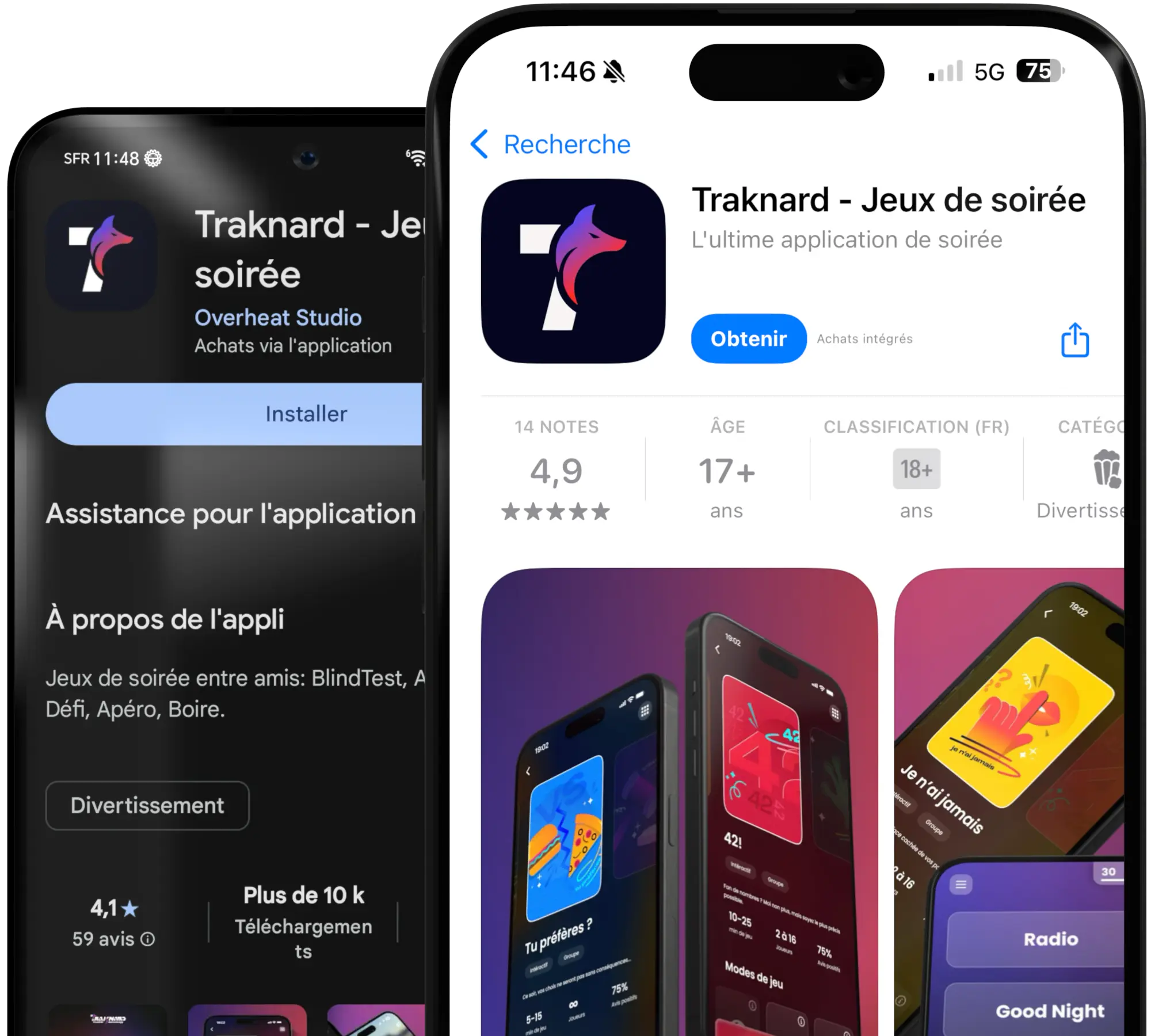
Poker Face is available directly in the Traknard app, in the Interactions section. Difficulty: 2/5 — accessible to everyone, but ridiculously hard to master when the trap is really nasty. It's one of the most-played mini-games in the section, and for good reason: it doesn't ask for anything you don't already have on the table.
"The moment someone tries to smile normally after downing pure lemon juice… that's the best moment of the night." — Every group that's played Poker Face, at some point.
What you need to play
The great thing about Poker Face is it asks for almost nothing. No board, no cards, no app required to play (though Traknard serves up the rules on a plate). Here's the complete list:
- Two drinks that look identical: one with a nice, normal taste and one with a surprising taste (very sour, very spicy, very bitter…). The key is they look the same in the glass.
- Enough glasses: one for each player in the drinking team, plus a few spares if you're playing multiple rounds.
- At least 4 players to form two teams (2 vs 2 minimum, but it's way more fun with 6 or 8).
- A bit of discreet organisation: someone needs to prep the glasses out of sight so nobody knows which one's spiked.
- Good faith: no verbal hints, no knowing winks — the game relies entirely on honest expressions.
Spiked drink ideas: concrete combos
This is where people often get stuck. Here are some combos that work really well:
- Water vs ice-cold sparkling water with pure lemon: the acidity triggers an almost automatic grimace.
- Orange juice vs pure lemon juice: similar colour, radically different taste — perfect for non-drinkers.
- Plain soda vs soda with a few drops of diluted hot sauce: the effect is gradual, so even harder to hide.
- Water vs water with cider vinegar: subtle to look at, brutal to taste.
- Beer vs beer with a shot of concentrated lemon juice: for alcoholic versions (18+, drink responsibly).
- Fruity mocktail vs mocktail with very bitter pomegranate syrup: ideal for mixed drinker/non-drinker nights.
The idea is the spiked drink is surprising enough to trigger a natural reaction, but never dangerous. No pure cayenne pepper, no dodgy mixes — we're playing for laughs, not a trip to A&E.
Poker Face rules, step by step
The official rules as they appear in Traknard, laid out clearly. One rule = one item, zero ambiguity.
Setup
- Form two teams: the drinking team and the guessing team. You can also play solo on the guessing team.
- Prep the drinks: one with a nice taste and one spiked drink that looks identical. Someone neutral (or taking turns) fills the glasses out of sight.
- Serve the glasses: as many glasses as players in the drinking team, with exactly one spiked glass among them.
Round flow
- The drinking team grabs their glass at the same time — nobody starts before the others, everyone drinks together.
- Tasting in silence with no reaction: no expression, no comment, no verbal hints. The drinkers keep their poker face throughout the whole tasting.
- The guessing team watches carefully: they can look, move around for a better view, but can't touch the glasses or ask questions.
- The guessing team picks someone: they have to point at someone specific — not "we're not really sure".
Penalties
- If the guessing team is right: the drinking team takes a penalty (a drink, a dare, an action — you decide at the start).
- If the guessing team is wrong: they take the penalty.
- Swap roles: after each round, teams switch — drinkers become guessers, guessers become drinkers.
Key points to remember
- No verbal hints allowed, even after the round.
- The spiked drink must be decided and prepped before players sit down.
- If a player laughs or reacts visibly before the other team even picks someone, the round can be cancelled at the group's discretion.
The golden rule: how to keep your poker face ?
This is where it gets really interesting. Keeping a poker face after drinking something atrociously sour is an art form. Here are the real tips — not a drama class, just advice from mates who've lost too many times.
- Eye control: fix a neutral point in front of you, or look at the other team with confidence. Avoid looking down, blinking too fast, or glancing at your glass after drinking.
- Steady breathing: the reflex when you get a taste shock is to hold your breath or exhale sharply. Train yourself to breathe out slowly and evenly, like you just drank water.
- Body position: stay relaxed, shoulders down. An involuntary shoulder shrug or neck tension is visible from a mile away.
- Swallowing timing: this is the hardest part. When the taste is surprising, you tend to swallow too fast or hold back. Try to swallow at the same pace as the other players — synchronisation is your best mate.
- Mentally prepare a "neutral expression": before drinking, think of something boring, slightly dull. It helps anchor your face in a baseline expression.
- Don't overplay it: paradoxically, someone who smiles too naturally after getting the spike sometimes attracts more attention than a slightly flat expression. Neutral, not a performance.
The real secret to poker face isn't hiding a reaction, it's not having one. Mentally prepare for the taste, even if you don't know which one you'll get — it preps you to absorb the shock without flinching.
Classic pitfalls to avoid
- Looking at your drinking team mates right after drinking (the knowing look that gives everything away).
- Setting your glass down too fast or too slow compared to the others.
- Clearing your throat "discreetly" — nobody's fooled.
- Forcing a smile that looks like a disguised grimace.
- Crossing your arms or touching your face right after drinking.
Variations to spice things up ?
The basic format is already pretty fun, but if your group starts getting too good at bluffing, here's how to level up.
Advanced Poker Face: multiple spiked glasses
In this version, instead of one spiked glass among normal ones, you slip in two or three. The guessing team then has to identify all the spiked players — and if they miss one, the penalty still applies. It makes the tasting even more stressful for the drinking team, because even those with normal glasses have to be careful not to react by mimicking others.
Solo Poker Face: every person for themselves
No teams here. Everyone drinks at the same time, and one glass is spiked. Then the whole group votes to pick who got the spike. Whoever gets the most votes takes the penalty — whether they actually got the spike or not. It adds a social and strategic layer: you can try to deflect suspicion onto someone else by looking at them suspiciously after drinking.
Custom ideas to adjust difficulty
- "Double Bluff" mode: the player with the spike can, if they keep their poker face, pick someone else in their team to take the penalty instead. Creates internal betrayal and guaranteed laughs.
- "Live Commentary" mode: the guessing team gets 30 seconds to comment out loud on what they see ("their eyes are shining", "they swallowed too fast") before picking. Makes the observation phase way more fun.
- "Timer" mode: the drinking team has to keep their poker face for 60 seconds after drinking, not just during the tasting. The clock's ticking, pressure's rising.
- "Elimination" mode: over multiple rounds, any player who gets caught is out. Last one standing wins.
Who is Poker Face for?
The good news is Poker Face works for almost any crowd. Here's where it really shines:
- A casual hangout with close mates: this is where the game's most fun, because you know each other's tells. You know Lea always squints when she's surprised, Tom holds his breath when shocked. This context turns the game into a battle of mutual knowledge.
- The night when the vibe drops: classic scenario — 10pm, the playlist's on repeat, nobody knows what to suggest. Poker Face launches in two minutes and gets things going again immediately.
- Groups of 4 to 10 players: below 4, the game lacks punch. Above 10, the observation phase gets a bit chaotic — unless you play Solo mode.
- Mixed drinker/non-drinker nights: this might be the most important point. Poker Face works perfectly without alcohol. The bluffing principle stays intact with lemon juice vs orange juice, sparkling water vs water with vinegar, or plain soda vs soda with diluted hot sauce. Nobody's left out, everyone plays.
What might not work as well
- Groups that barely know each other (the observation phase is less fun if you don't know each other's tells — though it can be a good icebreaker).
- Very loud parties where concentration's tough — the observation phase needs some quiet.
- Groups bigger than 12 without tweaking the rules.
If you're after other mini-games to round out your night, check out the Interactions section on Traknard: The Timer, Stare Down or Caps chain perfectly with Poker Face to mix things up between rounds.
Round recap: how a full round plays out
To make it crystal clear at a glance, here's how a Poker Face round goes, with each team's role at every stage:
| Stage | Drinking Team | Guessing Team |
|---|---|---|
| 1. Glass prep | Don't watch the prep — turn away or step back while glasses are being filled. | Preps the glasses out of sight (or a neutral player does) by slipping the spike into a random glass. |
| 2. Glass distribution | Each player gets a glass without knowing which is spiked. Nobody picks their own glass. | Gets into position across from them, ready to watch. Doesn't touch the glasses. |
| 3. Simultaneous tasting | Drinks at the same time as teammates, with zero facial, verbal or physical reaction. Keeps poker face throughout the whole tasting. | Watches each player carefully: eyes, swallowing, posture, micro-expressions. Can move for a better view, but doesn't talk yet. |
| 4. Extended observation | Keeps neutral expression even after putting the glass down. No verbal hints allowed. | Quietly discusses with teammates to agree on their pick. Can comment out loud on what they've observed. |
| 5. Picking | Waits for the verdict without reacting — even if the pick is wrong, no sigh of relief! | Picks a specific player from the other team. The pick must be clear and final. |
| 6. Reveal | The spiked player reveals themselves (or gets revealed). If the pick is right, the drinking team takes a penalty. | If the pick is wrong, the guessing team takes the penalty. |
| 7. Penalty time | Takes the penalty if they got caught (extra drink, dare, action — based on rules set at the start). | Takes the penalty if they picked wrong. |
| 8. Role swap | Becomes the guessing team for the next round. | Becomes the drinking team for the next round. Preps glasses for the next round. |
FAQ — All your Poker Face questions ?
How do you play Poker Face at a party?
Answer: Simple: two teams face off. One drinks glasses, one of which is spiked with a surprisingly different taste, the other watches and tries to guess who got the bad glass by reading expressions. If the guessing team's right, the drinking team gets a penalty — and vice versa. A round takes less than two minutes, and roles swap each time. You can kick off a game in under 30 seconds of explanation, making it perfect for reviving a flagging night.
How many players do you need for Poker Face?
Answer: Minimum is 4 (2 per team), but the game really comes alive from 6 onwards. Between 6 and 10, the observation phase becomes a real spectacle: the more players in the drinking team, the harder it is to watch them all at once, and the more intense the collective bluff becomes. Above 10, switch to Solo mode to keep the pace.
Can you play Poker Face without alcohol?
Answer: Absolutely — and it's actually recommended for mixed nights. The bluffing principle stays 100% intact with alcohol-free alternatives. A few combos that work really well: pure lemon juice vs orange juice, water with cider vinegar vs plain water, plain soda vs soda with a few drops of diluted hot sauce. The key is the two drinks look the same in the glass. The taste reaction does the rest — and trust us, keeping a poker face after pure lemon juice is just as hard as anything else.
What drink should you use as the spike in Poker Face?
Answer: Golden rule: the spiked drink must look like the normal drink but taste radically different. Very sour (pure lemon, diluted vinegar), very spicy (diluted hot sauce in soda), very bitter (sugar-free tonic vs sweet soda) — pick based on your group. Avoid anything risky: no concentrated chilli, no dodgy mixes. The goal is an involuntary grimace, not a health issue. Agree together on the "spike level" before you start.
What are the penalties in Poker Face?
Answer: Penalties are up to you — your group decides before you start. Most common: an extra drink (for alcohol versions, 18+, drink responsibly), a dare set by the other team, or an action from another Traknard mini-game like Truth or Dare or The Court. For non-alcoholic games, penalties can be physical challenges or embarrassing questions. The important thing is setting the rules before you play to avoid arguments.
What are the variations of Poker Face?
Answer: Two official variations in Traknard: Advanced Poker Face, where multiple glasses are spiked (the guessing team has to spot them all), and Solo Poker Face, where everyone plays for themselves and votes to pick the spiked player. Beyond that, you can make your own: timer mode (keep poker face 60 seconds after drinking), double bluff mode (the spiked player can pick a teammate to take the penalty instead), live commentary mode (guessing team comments out loud on what they see), or elimination mode (eliminated players sit out over multiple rounds).
How do you not give yourself away when you've got the spiked drink?
Answer: Four pillars of the perfect poker face: control your eyes (fix a neutral point, avoid looking down), manage your breathing (breathe out slowly and steadily, don't hold your breath), keep a relaxed posture (shoulders down, no neck tension or hand clenching) and sync your swallowing with the other players. The key is synchronisation — if everyone drinks and sets their glass down at the same pace, it's way harder to spot an isolated reaction. Mentally prepare for the taste shock before drinking, even if you don't know what you're getting.
What party game is Poker Face similar to?
Answer: Poker Face shares the bluffing DNA with classics like Pyramid or Shot Roulette, but stands apart with its team format and zero need for cards or special gear. It's also close to Stare Down on Traknard (keeping an expression under the pressure of someone's gaze), but with a taste element added. If you dig Poker Face, you'll probably love The Timer and Caps — two other mini-games in Interactions that play on pressure and focus.
Your turn to play ?
Poker Face is exactly the kind of mini-game that turns an ordinary hangout into a night you'll remember. No prep needed — two drinks, some glasses, and mates ready to lie to each other's faces. The rest is pure bluff, observation, and laughs when someone cracks at the worst possible moment.
You'll find Poker Face straight in the Interactions section of Traknard, with all the rules and variations just two taps away. And if you want to chain mini-games together, explore the Games section of the app too — Truth or Dare, Would You Rather or Never Have I Ever chain perfectly with Poker Face for a night that never drops. For cocktails, the Cocktails section of Traknard has recipes like Mojito or Cuba Libre to go with your games — alcoholic or mocktail versions depending on what your group fancies.
Quick recap
To kick off a quick game:
→ 4 players minimum, two drinks that look the same, one spiked glass, you're good to go.
For non-drinkers:
→ Lemon juice vs orange juice, diluted hot sauce vs soda — the bluff works exactly the same.
To level up:
→ Switch to Advanced Poker Face (multiple spikes) or Solo mode (group vote) for more intense rounds.
To keep your poker face:
→ Sync your swallowing with the others, control your eyes, breathe slowly — and mentally prepare for the shock.
To keep the night going:
→ Chain it with The Timer, Stare Down or Truth or Dare on Traknard to keep the energy up.
The real question isn't whether you'll crack. It's when — and whether your mates will spot it before you do. ??
Traknard is 18+. Drinking games should be played responsibly. Remember to pick a sober driver or book a taxi/Uber for the end of the night.